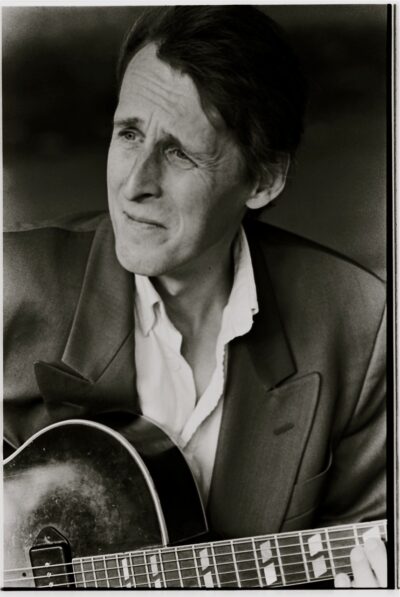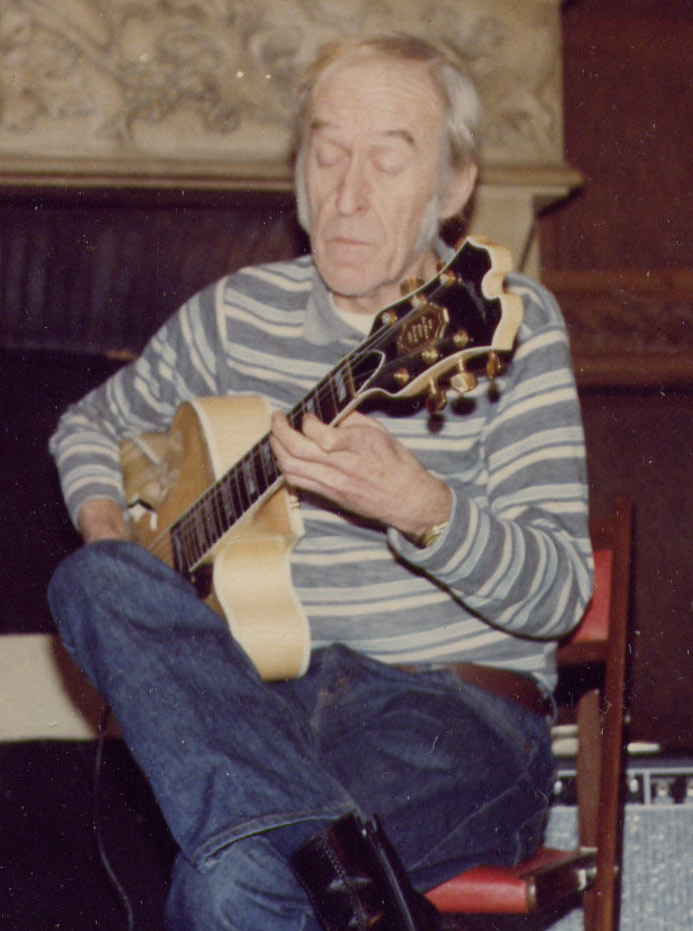
Last year’s Jimmy Raney Birthday article, Bebop Is Harder Than You Think, centered around Jimmy’s unparalleled mastery of uptempo bebop playing — playing cogently while the tempo threatens to leave you in the dust. This year, we’re going in the opposite direction with his ballad playing, where the challenge isn’t how you play when you have no time to think — it’s what you play when you have all the time in the world; the onus is to play something meaningful that touches people, or leave your soul hanging out to dry.
Can you hand me a towel? I feel naked
My father often said, “Well what does the player sound like when slowed down? That is where you true gifts really show themselves.” Without the supports of changes and jazz rhythm to push the solo and inspiration along, you are relying on your sheer inventiveness and sense of melody. Where stock riffs might’ve carried the day, you now have to dig deep and find just the right combination of ideas to meet the moment and communicate real feeling to the audience. There’s no where to hide, in other words, you’re exposed.
To explain how this unique problem is solved, allow me to introduce some thoughts on the following:
- Sequential expansion
- Multitemporality
Sequential expansion is a concept I introduced in my 2024 article, “Evolving Sequence”: Is That Really a Thing? and the Jimmy Raney Book, but probably bears repeating given you find a lot of it in Jimmy’s playing. This was the “Darn that Dream” example used with audio and music:
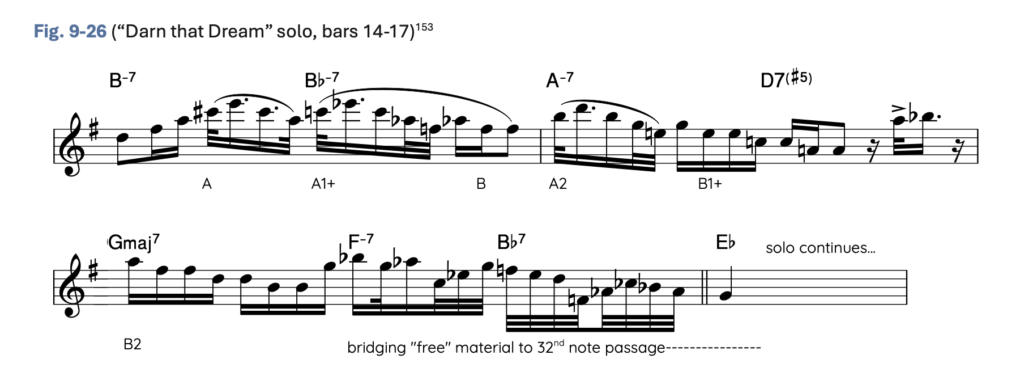
To explain the letter references above briefly, essentially a letter indicates a theme (A), a number introduces a non-strict imitation (A1), a plus indicates an expansion on the previous theme (A1+). Note how the 32nd notes almost seem an inevitable consequence of the building thematic and rhythmic energy, as he plays with extended 11th and 9th arpeggios, double noted themes and variation that builds upon the initial theme.
In the Raney style the increase in note speed is not “chosen” to impress, it is more a rhetorical device where new ideas spring forth organically, are more rapid, numerous, varied and expansive. They reveal an energy that was lying in wait, ready to express itself. This seems to make the choices he makes seem inevitable because they are driven by logical development.
A New Wrinkle in Time…
The “revealed energy” idea segues nicely to the next concept, multi-temporality. In many ways it relates to jazz analysis concepts mentioned previously, polyrhythm and polymeter. However I personally view polyrhythm as more of active application of one meter against another whereas multi-temporality is more of a latent possibility or avenue of other meters existing at the same time as the current bpm.
In Jimmy’s case, his inventiveness stems from his ability to shift to any available implied tempo at any moment. As an example you might hear the drummer slip into double time 16ths as the guitar energy moves there and suddenly Jimmy shifts gear to 32nds causing the feel to slow down and measure his new time superimposition. This is something that is often not apparent in other players in my view but is also a direct pipeline back to his idol, Charlie Parker. I have often noted the experience of listening to Parker in another room, where I can’t hear the rhythm section and being unsure whether he was playing a ballad or uptempo based on his lines.
This avenue really opens up more musical real estate on the ballad, where what might’ve been seen as a confining disciplined slow pulse with long change durations is now seen as as wide open expanse of possibilities.
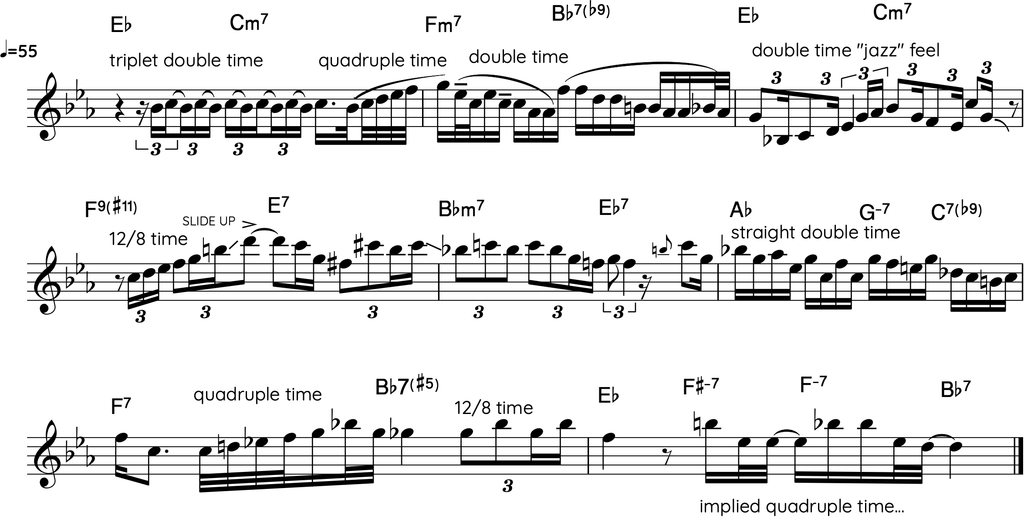
His playing on the ballad, “These Foolish Things” from his live concert with Cal Collins in 1987 I think demonstrate some these time concepts very clearly. This excerpt comes from the last A as Cal passes the baton to Jimmy from the bridge. As you can see, there is a wide variety of implied tempi on display in a short space of time. You also see that double note concept again featured in the Darn that Dream example. I find it “declarative” which again draws an analogy to rhetoric.
Papa Found a Brand New Bag
If there is one ultimate takeaway from analyzing Jimmy’s ballad concepts, it is that a slow tempo was never a limitation for his imagination—it was an invitation. Where other players might panic and try to fill the ballad void with their best bag of tricks, Jimmy saw a vast, multi-layered architecture of available time. By masterfully controlling the momentum and pulling the rhythm section along with him, he created a self-contained musical universe that felt completely inevitable.
Every year on August 20th, diving back into Dad’s music reminds me that his genius wasn’t just about the blinding speed or his technique, but the deep, multi-dimensional soul he brought to the music when things slowed down.
Happy Birthday, Dad. Your music still teaches us how to find something new that we can borrow from.
Discover more from The Raney Legacy
Subscribe to get the latest posts sent to your email.