The Middle Period: Studio Recordings, Family Life and the Bohemian Lifestyle
page 1 | page 2 | page 3 | page 4 | page 5 | page 6 | page 7 | page 8| page 9|
If 1950-1954 were Jimmy’s glory years, then the period directly after were the “make a living” years. Very few jazz artists, including Jimmy, could truly make a living playing jazz venues in New York. There were in fact fewer jazz clubs than there are now, with many of the big ones from the heyday on 52nd street having already closed down. With a new family to support (Doug was born on August 29th, 1956), The Raney’s moved out of Manhattan into cheaper apartments in Queens. 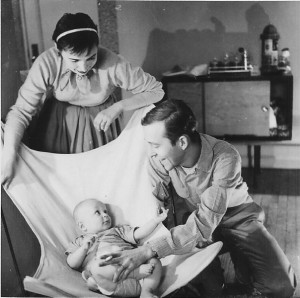
During this period, Jimmy had a steady gig with Mabel Mercer’s pianist Jimmy Lyon at the famed Blue Angel supper club which would continue until 1960. The club was famous for having launched the careers of many famous comedians and Hollywood celebrities such as Jonathan Winters, Orson Bean, Elaine May & Mike Nichols, and Woody Allen (to name a few) who Jimmy and Lee became friendly with many of them. Jimmy learned a lot of songs from Lyon as well as his harmonies which were drawn from Lyon’s mentor, Art Tatum. Lyon was well known for being the house pianist at the Waldorf Astoria playing on Cole Porter’s original piano and being an expert at his music. On an interesting sidenote, Dad and I visited him there in 1980. He was a terrific solo pianist. I actually got the nerve to sit in and really didn’t know much at that point. I requested the Evans’ favorite, “Emily” and surprisingly, he had forgotten it. He played another Evans’ favorite and Johnny Mercer penned tune, “A Time for Love” instead. But my father cackled later at how serious Lyon got having forgotten “Emily” given his encyclopedic knowledge of standards. “Oh my God, if Johnny Mercer walked in and I had forgotten his tune, I’d never live that down!
Jimmy needed to take regular studio work to get by. The hiring practices in New York studio recording jobs were much different in the 50’s. The “lobby” of the Local 802 union was essentially the local bars near the recording studios, such as Jim & Andy’s and the China Song. It was quite common practice for studio recording date calls to come directly into the club with the requested or available musicians picking up, likely from a dedicated phone line. However, early on in his career, he was confronted by the daunting task of serious sight reading that some studio dates imposed. Most dates called upon his jazz skills, with typical chord charts and minor indications and solo sections; however, at some point, he became increasingly faced with parts “black with notes” as he described. To avoid the embarrassment of not being able to cut the music he was paid to play, he decided to stop taking dates for six months and do some serious work on his sight reading. He recounts the experience in this video from my channel on YouTube. After this shedding period, he returned to the studio, comfortable that he could handle most jobs for which he was called. By his own account, he was not the first call studio guitarist, Barry Galbraith and Tony Mottola were. Nevertheless, Jimmy over his career was on at least 180 known recordings and counting re-releasing and re-compilations, much more than that. There are a great number of the recordings that he doesn’t even remember doing. With the way some dates went, he could be in a room with the cans on, cut his part, pick up his check and leave, having very little if any contact with the other musicians.
Jimmy became a recording artist for ABC/Paramount in 1956, which was the same time that Creed Taylor became the producer for the label. (Jimmy would still record as a sideman for Prestige). The two albums he did were Jimmy Raney Featuring Bob Brookmeyer and Jimmy Raney in Three Attitudes. The latter record was cobbled together from 3 separate dates and personnel (two quintets, 1 quartet). These particular records are many guitarists’ favorites (see Alan Holdsworth quote here) and the “Attitudes” record has recently gone back into print. Jimmy considered the Brookmeyer date his best work up until that point. There is a the real lift in the rhythm section provided by Teddy Kotick, Osie Johnson and pianists Dick Katz and Hank Jones. Along with the inspiring solos and musicianship of Bob Brookmeyer, how could you go wrong? This group gives Jimmy’s line the support that (I find) is sometimes lacking on early records, where it sounds almost like he’s steering the boat on his own. Hank Jones is one of the finest accompanists there are – providing both propulsion and uncanny taste which is something that may have not been present on Jimmy’s records since his work with Al Haig. 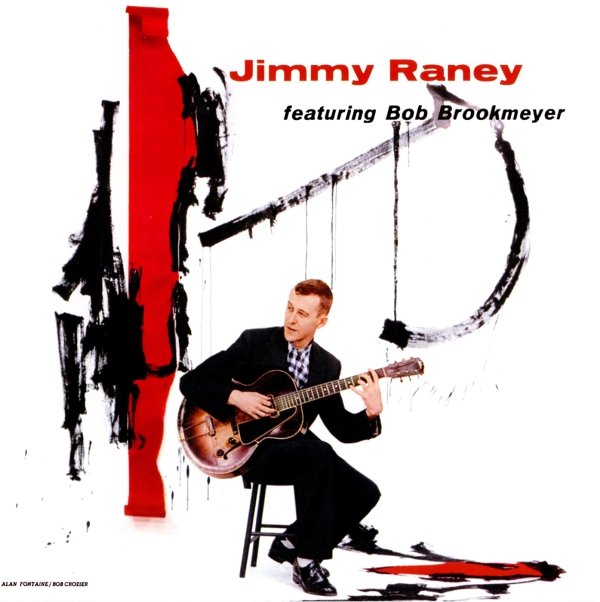 Dad often talked about his issues with drummers. He didn’t like aggressive drummers that covered him when he played and jacked up the tempo in the process. He was extremely sensitive to tempo so it is likely that his choices of steady drummers with good time was preferable to him. With the great studio drummer, Osie Johnson he had the best of both worlds. A sample of Jimmy’s fine work on his own original ‘The Flag is Up” is offered on the transcription page. Given that these were the only records as a leader he was to make for the label, (he was a sideman on Vinnie Burke All-Stars) I would have to imagine that his relationship with the company and Creed Taylor wasn’t a fruitful one.
He continued to make recordings as a sideman through the late 50’s for other record companies like RCA and Prestige, including several albums with Teddy Charles Tentet, which have recently become available again. He made the fairly notable record, Two Guitars with Kenny Burrell, Donald Byrd, Jackie McLean and Mal Waldron for Prestige in 1957. Without getting into too many details, Kenny and Jimmy were good friends, but he doesn’t recollect the experience too much, only that he didn’t enjoy it much. It was just one of those studio dates described earlier, where he read his parts and took some solos. Still he does contribute many fine solos on this record.
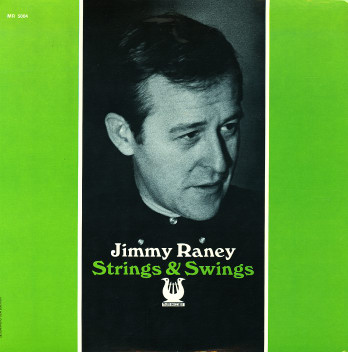 He was living a rich life at home, however. He continued to paint, play the cello, study scores and continue compositional studies with Hall Overton. In particular, he studied Bela Bartok’s string quartets #1-6. He played along with Music Minus One Cello studies of Beethoven. All this came to fruition, culminating in the tour de force recording, “Suite for Guitar Quintet”, Strings & Swings for Muse Records in 1972. Listen to the lovely, Pari Passu 04 – Pari Passu
The Jazz Loft
Jimmy would collaborate and hang with his friends Bob Brookmeyer and Jim Hall a lot during this period. They made the recording The Street Swingers in 1957. Together, they checked out music, did gigs together, jammed or just drank. Much of this period is captured in photos and music at the famous Overton-Cary-Smith-Young loft studio which includes the playing of Brookmeyer, Hall, Raney, Zoot Sims and many others. Hall Overton also put together his famous orchestration of Monk’s compositions there. In terms of the recordings that were made at these sessions, I think I should clarify some things for the record.
Although the documentarians would like to peddle the importance of what they are doing and how musicians were complicit in the recording, let’s call a spade a spade, shall we? This project is a business venture. They are doing exactly what artists and musicians often get testy about—capturing their artistic input for free and then turning around later and trying to turn a profit on it for themselves. The intent is the key. The Bradley tapes of my father put out by Fresh Sound Records (the ultimate vulture capitalist storefront operation) is a great example of this.
People say that it’s purely archival, but it’s more frequently a lie. Eugene Smith’s was a photographer not a musician. He was one of the people sharing the space. The musicians that were really the magnet, Hall Overton and Dick Cary, were at the head of that. They had many great musicians as friends. Smith was recording these people because he knew that one day this material would be valuable. Musicians came there because they love to play. And the best musicians around were dropping in. Smith and company were taking advantage of the situation. Throw in his photography of the musicians and you have a goldmine. Dave Young also had his own angle on this project which was to incorporate his artwork. This slightly predated Smith’s take on the loft project. In fact this battle over who got to exploit the documented audio material, Smith or Young, led to a “cat fight over the chicken bones”.
Young called me a few times about granting my consent to these recordings that included my father. I told him point-blank that I thought it was a bootleg. He was offended at my characterization, citing what the documentarians are now (Sam Stephenson for example) saying that the artists that knew they were being recorded. I refuted that argument, telling him, “They might’ve known they were being recorded but they didn’t know that you guys would turn around years later and try to make money off them!” He said nothing to that. Jim Eigo who was put in charge of this also was calling me about it. Basically when people are pressuring you to make a decision, it’s because they want to make money on something. Money was never offered in the beginning. Eigo wanted me to relent and just grant consent based on Young being ill and that it wasn’t really going to make much money.
In the end, I had Jimmy’s companion, the late Ola Miracle, draft a legal document granting consent. To his credit, Eigo was probably instrumental for at least some musicians gaining record date royalties posthumously for their work. I basically took the high road because risking the legal battle with the number of living artists (including Jim Hall) or heirs would have probably been more costly. One of the stipulations made in the document is that this consent for the recordings for the Dave X Young Loft Project would be limited to this project only. I don’t think they have kept to that. I knew that once I did this, it opened the door to Eugene Smith who had intentions to claim ownership of these tapes as well.
The project continues to find venues in various museum shows, photography, and concerts. I am told pictures of my mother even show up in one of the shows. I was never told anything. Granted, people are fascinated by musical history and this is something the public has a right to know about. I am just presenting the other side. This project just leaves a bad taste in my mouth.
page 1 | page 2 | page 3 | page 4 | page 5 | page 6 | page 7 | page 8| page 9|